


Stop Trying to Feel Better Tonight
Some nights aren’t meant to be fixed. Gloria Travers delivers a powerful modern folk performance about acceptance, emotional rest, and…


When an Immigration and Customs Enforcement agent shot and killed Renee Nicole Good in Minneapolis on January 7, 2026, the Department of Justice had exactly one job: investigate whether a federal officer violated someone's constitutional rights. They chose silence instead. Not confusion. Not delay. Silence. That silence isn't bureaucratic incompetence—it's institutional abandonment of the one mechanism designed to prevent state violence from becoming state policy. History has seen this movie before, and it doesn't end with apologies.

The legend of King Arthur and the Camelot vision has echoed through centuries, offering us more than knights and battles. Within the myth lies a timeless story of justice, loyalty, and renewal. From the Round Table’s promise of equality to Camelot’s fall from grace, the lessons remain urgent. In rediscovering King Arthur, we glimpse our own search for leadership, integrity, and the possibility of a better tomorrow.

What does it really take to feel happy? The answer isn’t just about money, it’s about the inequality around you. In unequal societies, the amount of income needed to feel “enough” keeps rising. This article looks at how income happiness is shaped by inequality happiness, why comparisons matter, and what this means for our well-being and the society we build together.

Insurance shrinkflation is the hidden crisis of 2025. As premiums climb, many policies now cover less while charging more. Like food product shrinkage, insurers quietly reduce coverage or raise deductibles without lowering prices. This means families are paying higher premiums for weaker protection. Understanding insurance shrinkflation is essential for protecting your financial security and making smart, empowered decisions about coverage.
 Black women jobs in the federal workforce are disappearing at alarming rates, stripping away hard-won pathways to stability. As Trump’s cuts target agencies with high Black women representation, families lose security, benefits, and income. This is more than statistics, it’s a structural crisis that undermines the entire economy. When Black women lose jobs, America loses a cornerstone of its workforce and its future.

The racial wealth gap in America is no accident, it’s a legacy of policies, practices, and attitudes stretching back generations. While the headlines focus on surface-level solutions, the real roots run deeper. Understanding racial wealth and its entrenched history is the first step to building a truly fair and inclusive economy.

Have you ever felt like the world sees you less and less as a person and more as a profile, a data set, a consumer waiting to be analyzed? You’re not imagining it. Somewhere along the way, your digital shadow started speaking louder than your real voice, and nobody asked for your permission. This isn’t just a tech problem. It’s a soul-level issue. And it’s time we talked about it.

AI-powered personalized pricing is changing how businesses charge you—sometimes charging more just because they can. This profit-maximizing strategy thrives on your digital footprint. But there’s one simple, powerful weapon you still hold: cash. In this article, learn how your spending data is used against you and how paying with paper money can protect you in the algorithmic age.

That free weather app may be forecasting more than rain—it's tracking your every move. Here's how your data is being used, sold, and surveilled.

Think your private life is actually private? Think again. Your data has been bought, sold, sliced, diced, and served up to both corporate America and Uncle Sam — all while you were busy Googling cat videos or filing your taxes. Welcome to the era where your "digital soul" is currency, and you didn’t even get a receipt.

Karma and justice often feel elusive, especially in a world filled with inequality and suffering. In this article, we explore how collective karma shapes societal justice and what role we play in this interconnected web. Uncover the deep relationship between karma, fairness, and responsibility as you gain insight into how our actions ripple through the universe, impacting both individual and collective outcomes.

Corporate control through monopolies like Big Ag, Big Pharma, and Big Tech has a firm grip on America. This article uncovers how these giants stifle competition, manipulate politics, and harm everyday Americans, particularly in rural areas. Discover how the Biden administration is pushing back and what steps can be taken to restore economic democracy. It’s time to reclaim power from these monopolistic corporations.

The prevalence of SMS phishing scams is increasing in today's digital landscape. Recent research has provided new insights into the scope and sophistication of these scams.

Baseball, often dubbed America's pastime, carries a rich and diverse history that has shaped the nation's identity.
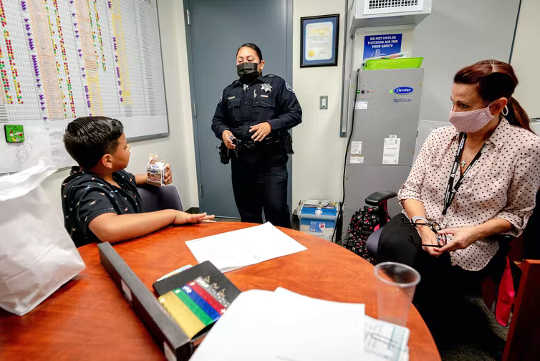
Increased police monitoring of young people leads to more school discipline referrals and arrests, typically of Black and Latino youth.

When you use the internet, you leave behind a trail of data, a set of digital footprints. These include your social media activities, web browsing behavior, health information, travel patterns, location maps, information about your mobile device use, photos, audio and video.

A new conceptual model depicts the complex relationship between policing and population health.

Most participants in a recent study had no idea that their email addresses and other personal information had been compromised in an average of five data breaches each.

The best way to reduce crime in the future is probably what caused it to drop in the first place: helping our families, neighborhoods, and schools raise kids who are respectful of others and don't need to steal to get by

Police academies provide little training in the kinds of skills necessary to meet officers’ growing public service role, according to my research.

In 1915, Gabrielle Darley killed a New Orleans man who had tricked her into a life of prostitution. She was tried, acquitted of murder and within a few years was living a new life under her married name, Melvin.

Passwords have been used for thousands of years as a means of identifying ourselves to others and in more recent times, to computers.

As survey results pile, it’s becoming clear Australians are sceptical about how their online data is tracked and used. But one question worth asking is: are our fears founded?