


Stop Trying to Feel Better Tonight
Some nights aren’t meant to be fixed. Gloria Travers delivers a powerful modern folk performance about acceptance, emotional rest, and…


Have you ever felt like the world sees you less and less as a person and more as a profile, a data set, a consumer waiting to be analyzed? You’re not imagining it. Somewhere along the way, your digital shadow started speaking louder than your real voice, and nobody asked for your permission. This isn’t just a tech problem. It’s a soul-level issue. And it’s time we talked about it.

That free weather app may be forecasting more than rain—it's tracking your every move. Here's how your data is being used, sold, and surveilled.
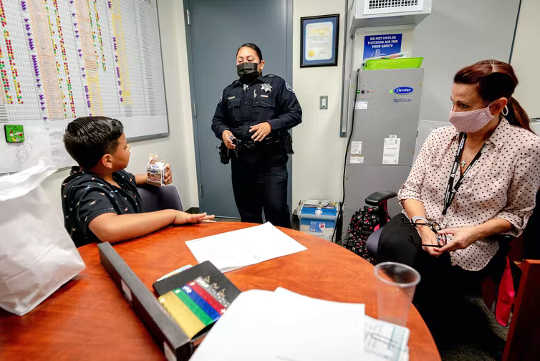
Increased police monitoring of young people leads to more school discipline referrals and arrests, typically of Black and Latino youth.

When you use the internet, you leave behind a trail of data, a set of digital footprints. These include your social media activities, web browsing behavior, health information, travel patterns, location maps, information about your mobile device use, photos, audio and video.

Most participants in a recent study had no idea that their email addresses and other personal information had been compromised in an average of five data breaches each.

In 1915, Gabrielle Darley killed a New Orleans man who had tricked her into a life of prostitution. She was tried, acquitted of murder and within a few years was living a new life under her married name, Melvin.

Passwords have been used for thousands of years as a means of identifying ourselves to others and in more recent times, to computers.

As survey results pile, it’s becoming clear Australians are sceptical about how their online data is tracked and used. But one question worth asking is: are our fears founded?

Ring promises to keep more neighbourhoods safe, but will smart surveillance systems really make you safer?

A 2019 surge of gang-related shootings in Toronto motivated the Ontario government to commit $3 million to double the number of Toronto Police surveillance cameras in the city.

Researchers discovered that Amazon’s Alexa, Apple’s Siri and Google Home can be hacked by laser pointers and flashlights.

We give out our cell phone numbers all the time, but those 10 digits also give companies a ton of information about us and how we live our lives.

My recent research increasingly focuses on how individuals can and do manipulate, or “game,” contemporary capitalism. It involves what social scientists call reflexivity and physicists call the observer effect.

Individuals and businesses unknowingly expose themselves to security and privacy threats, as experts explain here.

Social media platforms like Twitter, Instagram, and Facebook collect a staggering amount of data points from us, so much data that our social media activity can pretty accurately reveal things from gym habits to the state of our mental well-being.

A familiar scenario: as part of having your cholesterol checked, your clinician also orders a standard blood panel – a red blood-cell count, and then a breakdown showing the proportions of five types of white blood cells.

High-profile data breaches at companies like British Airways and Marriott get a lot of media coverage, but cybercriminals are increasingly going after community groups, schools, small businesses and municipal governments.

New proposed legislation by U.S. senators Mark R. Warner and Josh Hawley seeks to protect privacy by forcing tech companies to disclose the “true value” of their data to users.
 In January 2019, Liberal MP Adam Vaughan argued that privacy concerns about the smart city proposed for Toronto’s waterfront should not be allowed to “reverse 25 years of good, solid work and 40 years of dreaming on the Toronto waterfront.”

Seventy years ago, Eric Blair, writing under a pseudonym George Orwell, published “1984,” now generally considered a classic of dystopian fiction.

The notifications that companies send consumers about data breaches lack clarity and may add to customer confusion about whether their data is at risk, according to new research.
 On December 14, 2017, the Federal Communications Commission (FCC) voted to repeal its net neutrality rules, which critics say could make the internet more expensive and less accessible for Americans.

In criminal justice systems, credit markets, employment arenas, higher education admissions processes and even social media networks, data-driven algorithms now drive decision-making in ways that touch our economic, social and civic lives.